
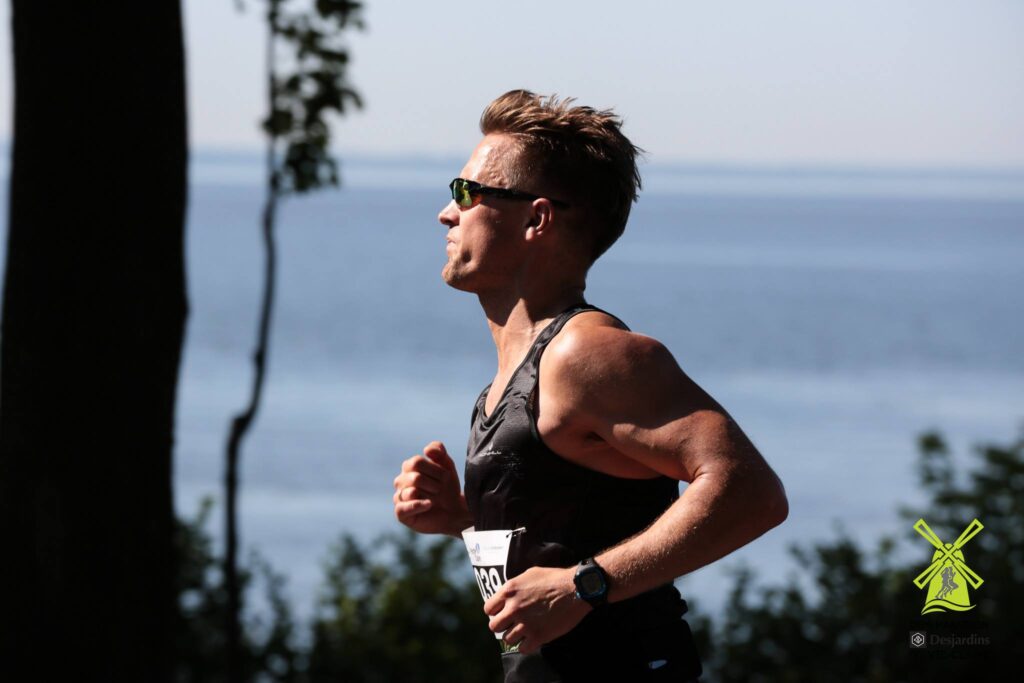
Most marathon runners know the wall, the point late in a race when the body runs out of fuel and the finish still feels a long way off. Few get past it on speed alone. What carries them through is pacing, patience and the right people running alongside them.
Drug development has a wall of its own. It tends to arrive years into a program, when a compound stalls or a study doesn’t read out the way anyone hoped. Rudi Erlemann has spent nearly two decades helping companies through that stretch, and he explains his approach with a proverb: “If you want to run fast, run alone. If you want to run far, run with friends.”
That idea shaped KreaMedica, the Montreal company he founded in 2009. It acts as a general contractor for drug development, running each program with the research organizations and specialists it needs. By Rudi’s estimate, a quarter to a third of its collaborators are runners themselves. His own career, though, began with a very different plan.
You set out to be a teacher, not a scientist. What pulled you off that course?
I came to science almost by accident. I was originally more interested in social work and in helping children and families create better opportunities for themselves. With that in mind, I wanted to become a teacher. In Germany, students are placed into different secondary school tracks, and I wanted to teach at a Hauptschule, where students weren’t necessarily set on a path to university. I felt that was where I could make the greatest difference.
Science teachers were in demand, so I went to Humboldt University in Berlin to study biology and physics. But the curriculum there wasn’t aligned with the state requirements, a legacy of the reunification. It wasn’t a good fit, so I switched to biophysics. That accident turned out to be very useful.
Is there still something of the teacher in the work you do now?
In a way, yes. A lot of my work is explaining and translating from one discipline to another. I gather information from clients and partners, identify what they need, then put it in terms our team and the CROs can understand. Biophysics prepared me for that. It forces you to be an all-rounder, and drug development is the same. But in the end, you’re dealing with people, and I like to bring them together.
How did you get from biophysics to founding KreaMedica?
After my PhD, I worked at Charles River Laboratories, where I learned how a contract research organization operates from the inside. In 2007, I joined InSymbiosis as the first scientist on the team. We supported biotech companies through functional outsourcing, and we developed that business model ourselves from scratch. In 2009, I started KreaMedica as a franchise of that company and continued in scientific project management for a couple of years. Fast forward ten years: by then I had moved into business development, and a regulatory partner we’d been collaborating with acquired InSymbiosis.
I worked with them for about a year and a half, and the experience taught me a great deal—not least about the kind of organization I wanted to build.
Some consultancies operate like hotel chains, with a standardized business model. I prefer to bring together carefully selected individuals who collaborate closely and develop genuine personal connections, almost as friends. So at the start of 2021, KreaMedica became independent. As the business grew, we also launched KreaConnect, a platform that connects biotech companies with experienced consultants. Think of it as Airbnb, but we curate the consultants and take on the burden of making the right match.
Teams that work almost as friends. How does that translate into running a drug program?
It starts with one person taking responsibility for the program as a whole. Many drug development programs have no single person accountable for how the pieces fit together. Each team does its own work well, but problems arise in the gaps between them.
That’s why we operate as the program’s general contractor. We oversee the entire program and manage the day-to-day work. We then bring in consultants as needed, much like a contractor brings in architects or engineers to address highly specific, often niche questions.
Setbacks are almost guaranteed in drug development. What makes a client relationship hold up when they come?
Trust, both scientific and personal. Something will go wrong. I don’t know when, what or to what degree. When it happens, direct communication matters, and it has to go both ways. The relationships I value most are the ones where we stop thinking of each other as service provider and client. We become one team working around one asset.
Sometimes that trust means advising a client to stop. Has that been tested?
Our work with Adamed Pharma in Poland comes to mind. They came to us in 2011 with a strong discovery team in central nervous system research, but they had never taken CNS molecules through preclinical development into the clinic. We worked together for nearly a decade, and much of that work was deciding which compounds were developable.
Over that time, we recommended stopping several lead compounds that looked promising but had problems that would have caught up with them later. At one point, Marcin Kołaczkowski, who led their CNS projects team, asked me why we kept killing his projects, when keeping them going would have made us more money. I told him I would rather see him come back with something new and succeed.
Did he?
He did. Eventually, one compound was out-licensed to Acadia Pharmaceuticals in 2021. Marcin also drew on what we learned together to create a master’s program in drug discovery and development at Jagiellonian University. It’s a partnership I’m very proud of.
What does your role at KreaMedica look like now?
For about nine years, I managed scientific projects myself. Today I’m no longer involved in day-to-day operations, except with companies we’ve invested in. Our teams lead the programs, and my focus is on the organization as a whole.
If there’s one thing I’m proud of, it’s the people we’ve brought in, who support one another and take ownership of their work. I only hire people I would be glad to work for if the cards were dealt differently. I borrowed that idea from Mark Zuckerberg, and it’s the most useful advice I can offer any manager or business owner. It comes down to one question: would you trust this person with your role?
Where do you want to take KreaMedica from here?
The core stays the same: bringing cost-efficient drug development expertise from Canada to the rest of the world and building strong, lasting relationships as we do it. From there, we want to expand our consulting network, connecting the right experts with biotech and pharmaceutical companies. We also want to use AI intelligently, to identify great consultants and take work off people’s shoulders. We’ll keep growing our strategic investments too. I invest when I believe in the science and the people, and it keeps my finger on the pulse of the biotech industry.
How did running become such a big part of KreaMedica?
This also came about by accident. I first ran with Jim Ellis of Nocion Therapeutics, then a client and now a friend, and he introduced me to other runners in the greater Boston area. In addition, there are usually running events at biotech conferences, and if I can’t find one, we create our own—KreaRuns.
Running fits our line of business. Drug development isn’t simply a marathon. Yes, there are many moments when endurance is required to keep going. But there are also plenty of sprints where you need to pick up the pace. And at some point, you will hit the wall. That’s when having friends and support around you is what allows you to go the distance.
There is another kind of support I don’t want to overlook: having a solid home base. To me, it’s like the water stations along a marathon course. You may be the one doing the running, but without that support, getting through the months of training and reaching the finish line becomes much harder.
Planning the next stretch of your program? Contact the KreaMedica team, or join us for a run at the next conference.